Pages

Tampilkan postingan dengan label more. Tampilkan semua postingan

Selasa, 14 Juni 2016

More Sites to Investigate and Invest Your Thoughts in

One of the absolute attractions of the internet is its ability to encourage our hunger for knowledge. It is the ultimate source. When Bill Gates was asked what the internet was for, He described its content as "STUFF". Really that pretty much sums it up. All sorts of stuff about everything.

Well heres some more STUFF.....

Starting with some commercial Aquaponics sites

http://host.madison.com/wsj/business/article_8e24c684-7641-11df-8ad2-001cc4c03286.html

http://host.madison.com/article_bb8f7f4a-763e-11df-a0b3-001cc4c03286.html

Congrats to the Tyner Acadamy
http://wdef.com/news/pef_awards_grants_to_innovative_educators/06/2010

And some DIY  Which I love to see.....

http://indoorgrowing.org/indoor-aquaponics-30gal-video-2/
http://120thingsin20years.blogspot.com/2010/06/aquaponics-exclusion-zone.html

If youd like to be able to show someone new to AP a thorough rundown of what A is, try this...
http://www.freegardeninghints.com/gardening-videos/aquaponics-grow-up-to-10-times-the-plants-in-half-the-time/

http://www.associatedcontent.com/article/5454414/sea_change_an_argument_for_aquaponics.html

Now, if this lot has not challenged you in some way, let me know. Or if you would like to see some other aspect of AP, again - Let Me Know - I would love to hear from you...

Ozzie
Read More..

Rabu, 11 Mei 2016

Grilled Cheese Smart Box Microcontroller And A Whole Lot More

The Smart Box uses a microcontroller (mcu), and a whole lot more, to keep fresh grilled cheese sandwiches hot, moist and crisp.
Fresh, tasty, warm grilled cheese sandwich

The Smart Box is an innovation that dramatically demonstrates two sometimes overlooked non-electronics aspects of MCU-focused projects that can require as much work as the electronics, if not more work. Those two non-electronics issues are:

  1. Figuring out what you need the MCU to control.
  2. Figuring out all the non-electronic hardware issues for the project.
The goal of the Smart Box designers was to create an environment that could extend the highly edible lifetime of a fresh grilled cheese from seven minutes to at least thirty minutes. As Fast Magazine tells the story, the design team tried to find,
"...a way to extend the sandwichs woefully short shelf life. They discovered that each Melt had about seven minutes before going cold, leaving the cheese to congeal and making for a subpar grilled cheese-eating experience...the team looked far and wide for a food transport box that could maintain just the right temperature while striking the right balance between moisture and crispiness for 30 to 60 minutes at a time...what we realized is that if you maintained the temperature, and you had even airflow, and a way to get some of the moisture out of the product as it sat in the box, that it can hold a Melt for over 20 minutes and still meet temperature, moisture, and crispness guidelines."
Sandwich container with ridges and holes for hot air circulation
The first part of the MCU project had nothing to do with an MCU. Most products and design projects involving an MCU will start by figuring out how the product or project ought to work to achieve the projects goal. For the Smart Box, the goal was a good tasting sandwich. So the first part of that project was to determine what ambient conditions would keep the sandwich from getting cold and soggy. It was obvious the grilled cheese sandwich storage and transport unit would need heat. They would have to keep the temperature low enough so it didnt cook the sandwich more, but high enough so the cheese would be nice and soft. And the temperature would need to be uniform throughout the sandwich storage and transport unit. After experimenting with different conditions, and probably eating quite a few grilled cheese sandwiches, they found the right temperature (190 - 200 degrees F) and the right moisture to keep the sandwich tasting good.

The next step was to develop a combination of materials, shapes, heaters, fans, etc, that would maintain the necessary temperature and moisture for the sandwiches. Air flow was key, both throughout the large insulated food transport box and throughout the smaller sandwich containers that sit on the shelves inside the food transport box. The majority of this physical design and development work didnt focus much on electronics of the project, other than to keep the fan pushing air and to keep the heater warming up the air. The Fast Company article explained:
"...for any of this to work, the air had to circulate around the sandwich so that the heat surrounding it was constant, like a convection oven with size restraints...Heres how it works: It uses a hot plate made out of aluminum to keep everything warm. But since direct heat can burn its contents, its covered with a shield while an internal fan ensures proper air circulation. The whole system is sensitive, so inside are sensors that monitor the environment for precise heat and humidity levels. A microcontroller is used to make small adjustments automatically, ensuring that the grilled cheese arrives at your door or desk nice and toasty."
Once the physical design of the box was mostly figured out, the electronics wizards started working their magic. They figured out what temperature sensors to use and where to put them. The fan power and controls were designed and the rest of the MCU functions were programmed.

Im sure figuring out the sensors, controls, MCU and programming took much longer than the length of the above paragraph indicates. But for the grilled cheese Smart Box, theres little doubt in my mind that the design-build issues requiring non-electronics maker skills or physical design knowledge took more time and brainpower than the MCU-related part of the project. The Smart Box illustrates why the Humboldt makers who really enjoy MCUs also need lots of other types of knowledge or need to collaborate with others who have the non-electronics skills.

**********
Read More..

Kamis, 05 Mei 2016

More Of The Best in AQUAPONICS


Feature Photo: Aquaponics Tomatoes

Tomatoes from Deb & Wayne Dorbands aquaponics garden west of Loveland, CO. Vegetables year-round that grow without soil in reclaimed containers. Good sustainability practice.
Photo: Deb Dorband

                                                ...oooOooo...

Aquaponics: Getting More Out of Less

February 21st, 2012
Charlie Price from the social enterprise Aquaponics UK, explores the role aquaponics can play in the future of our collective food supply. He provides an insight into both the applications for aquaponics but more specifically a new approach to urban agriculture, turning wastes into resources and transforming disused urban spaces to provide not only food, but resilient communities.

                                                ...oooOooo...

Rust Belt Cities and the New Urban Agrarianism

Milwaukees Growing Power has led the way in demonstrating that community-based food production is much more than beautification or an effort to latch on to sustainability fads. Founded in 1993 by Will Allen, the farm now feeds 10,000 people annually, grows 25,000 pots of vegetables in six greenhouses scattered across three urban acres and runs a food co-operative. Growing Powers greenhouses also feature an aquaponics system growing 10,000 fish at a time. The full article is well worth a READ

                                                ...oooOooo...


Construction on the PortFish Model 3 aquaponics system is moving along well.  The mild winter weather has been conducive for our work.


More photos are available in our Facebook gallery.

Check out the aquaponics page to see the floor plan and other details about the project.
Want to learn more about aquaponics and have some spare time to lend a hand? Volunteers are always welcome! You can also support the project by sending a donation. PortFish Ltd is a 501(c)(3) organization and your donations are tax deductible.

                                                ...oooOooo...


Basics of Aquaponics Workshop

    Aquaponics Workshop, Sustainable Carolina at City Roots
  • Who: Davis Johnson, Matt Kip, and Eric McClam (City Roots Farm Manager)
  • What: Basics of Aquaponics Workshop
          

The Sustainable Carolina Food Team will be offering a “Basics of Aquaponics” workshop as part of our series of garden workshops. Aquaponics is an alternative form of agriculture that combines hydroponics (growing plants in water rather than soil) and aquaculture (raising fish in ponds/tanks or a controlled environment, i.e. fish farming).
                                                ...oooOooo...


Sustainable Passive Solar Greenhouse – Aquaponics.

Murray Hallam. Good morning, my name is Murray Hallam of Practical Aquaponics and I’m here this morning talking to Cord and Penn Parmenter from  Wycliff in Colorado. Now I’ve been told that you pair are going to be at the … Continue reading ?

                                                ...oooOooo...


Students in FDL go back to basics

Moraine Park Technical College

Updated: Monday, 20 Feb 2012, 8:25 AM CST
Published : Monday, 20 Feb 2012, 5:24 AM CST
FOND DU LAC - Students apart of the Culinary Arts Department at Moraine Park Technical College are going back to basics.  FOX 11s Emily Deem stopped by the college in Fond du Lac to see what students are learning.
The schools Culinary Arts Department is doing some pretty awesome things with hydroponics, aquaponics and gardening.

                                                ...oooOooo...


HD Aquaponics Ep.30 - Advanced Barrel Aquaponics, swirl filter, floating raft, u-siphon, indoor

1,790
Uploaded by edpozek on 16 Feb 2012
This is the new Barrel Aquaponics system equipped with three stages of filtration, a floating raft or DWC system, along with two, five gallon grow beds. These five gallon grow beds use an external u-siphon to drain the bed
                                                ...oooOooo...


Canadian aquaponics greenhouse to employ biomass CHP system

By Luke Geiver | February 17, 2012
  • Seattle-based ecoTECH Energy Group has begun site work for a 5 MW biomass facility that will supply heat and power to an aquaponics greenhouse project near McBride, British Columbia.

                                                ...oooOooo...

..........and thats a wrap.
Hope I have fed you enough fishy stories and planted a couple of new ideas.
Back Soon

O Z Z I E
Read More..

Rabu, 04 Mei 2016

Atmel Microcontroller Powers Kickstarter Sci Fi Hoverbike

According to a recent post titled "Hoverbikes may soon become a reality," the futuristic hoverbike featured in an in-progress Kickstarter campaign is controlled by an Atmel ATmega32U4 microcontroller (MCU).
Cyborg Buster on scale model hovercraft

The Atmel post explains that the Kickstarter campaign supporters dont get a full-size human-carrying hovercraft, but rather a 1/3 size model of the airborne motorcycle current design.
"Hoverbikes may not be ready for your daily commute just yet, but thanks UK-based Malloy Aeronautics, we’re now a step closer. Debuting just days ago on Kickstarter, the firm is producing a one-third sized version of its design to help fund the full-sized prototype. “This drone was originally built as a proof of concept for our latest full-sized Hoverbike prototype...After testing the one-third Hoverbike, we realized that it had lots of features that made it a fantastic drone, not only this — selling this scale Hoverbike to the public would allow us to raise funds to continue the development of the manned version.”...the 1.15-meter-long mini replica can carry payloads of around 1.5kg and weighs in at 2.2kg unladen. The 3DR Pixhawk flight controller allows for it to be controlled remotely, as well as follow predetermined flight paths — or the pilot themselves — automatically. The mini-hoverbike also comes equipped with a third-scaled, 3D-printed humanoid ‘pilot’ complete with a space on its head specifically-designed for a GoPro camera."
Hovercraft folds up
There are several aspects of this MCU project and Kickstarter campaign worth remarking on, some of which come from my recent immersion in the world of MCUs and others from my years of covering aviation innovations for the Experimental Aircraft Association in Oshkosh, Wisconsin. The aspects of interest are:
  1. The MCU controlling the scale model is a relatively low-powered 8-bit AVR unit, the ATmega32U4. It would be interesting to know what their criteria was for choosing that specific MCU.
  2. Its kind of cool that the hoverbike project has spun off the Macro Micro Arduino-compatible board that can be bought for $50 from the Malloy Aeronautics hovercraft website. Thats an opportunity made possible by the open source concept of the Arduino ecosystem.
  3. The hovercraft folds up for transportation.
  4. I like the Cyborg Buster rider designed for and shown in pictures of the Kickstarter hovercraft. It will be 3D printed by people who want the lifelike figure, and it has a cavity in its head for a Go-Pro video camera. Creating an appealing cyborg which really has nothing to do with whether this
    Cyborg Buster
    is an airworthy hovercraft is an excellent marketing strategy.
  5. The quadcopter design of the hovercraft is unusual in that the two front props appear to partially overlap, as do the two in the rear. Im not an aeronautical engineer or pilot, but it would be interesting to know how that impacts the aerodynamics of the craft.
  6. The Kickstarter campaign page combines two stories -- one about the full-size hovercraft and one about the scale model quadcopter. Mixing the two stories like that may leave the reader somewhat unclear as to exactly what they are funding when they contribute to the campaign.
  7. The radical departure from traditional aircraft paradigms mean that the hoverbike Kickstarter supporters should not expect a commercial model of the full-size flight-ready hoverbike for quite a few years. Check the history of the Terrafugia Transition and the Martin Jetpack -- youll see what I mean.
With respect to the Atmel MCU and the scale model hoverbike quadcopter, the Kickstarter website says:
"If you have never flown a multicopter before, we highly recommend purchasing a small drone to practice with first (the Hubsan X4 is great to start with).  We designed this 1/3rd scale Hoverbike to be safe and robust, however without rc experience you will be sure to fly your brand new Hoverbike into the ground on the first day and there are practical limits to how strong we can make this!...Our MAcro Micro is an Arduino Micro compatible microcontroller that is easy to program, with 3A inputs and outputs, up to 30V in, analog out, and has hundreds of uses in robotics and home projects, including stepper motor driver, LED strip light controller, servo actuator, fan speed controller, brew kit controller, electric car window conversions...We designed this tiny board to drive the multicolor LEDs on the Hoverbike, and to allow owners of our 1/3rd Hoverbikee to do more with their drone than just look passively from the sky, by switching and actuating levers, release pins, spot lights via their radio or program."
UMaine Hover
Atmel MCUs have been used in the drone ArduPilots for quite a few years, but this hoverbike Kickstarter campaign shows the expanding non-engineering use of MCUs. In this case, the MCU is really being used as a marketing tool to raise R&D money, rather than just being the brains of the quadcopter autopilot.

On a related note for those readers interested in this type of personal aircraft, here are links to two other hoverbike projects. The first is for the UMaine Hover, a senior design project for a group of University of Maine students. Heres a link to the UMaine Hover website. The second project was the Aerofex hover
Aerofex hover bike
bike from a couple years ago. The LA Times article has a video of thats worth watching of a test run on the airborne personal sportcraft. Looks like it would have fun to pilot. Aerofex apparently made it clear that they werent planning to sell the aircraft as a human-piloted craft, but were rather using it as a drone development tool.

If the Humboldt Microcontrollers Group wanted to get involved with quadcopters, Id be all for that. My recommendation, though, would be to get some flying experience with a well
Parrot AR.Drone 2.0
tested one like the Parrot AR.Drone. Ive flown that a little, and it was both fun and relatively easy to keep in the air. One of the participants in a recent meeting of the MCU group had interesting stories to tell about his adventures with drones and MCUs. If you have built or flown an MCU-controlled quadcopter, consider coming to an upcoming meeting of the MCU group. The next meeting is on August 7th. Hope to see you there!

**********
Read More..

Sabtu, 30 April 2016

Arc Controller Motor Shield More Power!!

The August 21 article "Arduino Motor Shield, Arc-Controller Launched By Arc Robotics" gave me a good reason to do a little research on microcontroller (MCU) motor control and motor shields.
Arc-Controller motor shield

The article covers the Arc-Controller, a new high capacity motor shield that has a Kickstarter campaign in progress, telling us:
"Maker, developers and hobbyists that enjoy building Arduino platform based projects might be interested in a new Arduino Motor Shield called the Arc controller which has been created by Arc Robotics...“There have been a lot of amazing projects come out of the Maker revolution, however, many are limited by the capability of their motor controller. We want to change that. The Arc-Controller is a bridge to bring high Amp motor control to your projects, up to 43 amps with a heat sink. It is capable of variable speed and direction control over a single Stepper Motor or two DC motors, because when do you only need one motor. The Arc-Controller is compatible with about any Arduino, or other micro controller such as Raspberry Pi. It runs an ATMega328, and is user programmable via the Arduino IDE."
The Kickstarter campaign still has 36 days to go, but it has gotten off to a very slow start, with only $927 pledged of the $41,500 funding goal. According to the Arc-Controller Kickstarter page,
"The Arc-Controller built around two H-Bridges. Each one can supply 43 amps of continuous current, with a properly mounted heat shield. The dual H-Bridges run separately, controlling two high-end DC Motors or as one controlling a single stepper motor. Built into the H-Bridges are current and temperature fail-safes.  If they begin to get too hot, or if they exceed the maximum current levels, current limiting will take affect. They will automatically shut down until they cool off, or until conditions are safe to operate. We also have included a reverse polarity protection...There is an integrated circuit on board that gives a current reading from the H-Brides to see how much current each individual motor is using. This gives you the option to write your sketches to react under certain loads, detect shorts and over heating states...We are creating a simple library that can be used to easily send commands to the Arc Controller. These commands can configure the Arc Controller to run a stepper motor, drive two brushed DC motors, and even an integrated an XY thumb stick “Arcade Drive”. The interface library will take input from you and transmit it to any number of connected Arc Controllers...We have had lots of success with tank style robots to the point that we made it run on two wheels until you want it to act like a tank. then it will lay down and drive like a tank. We have many theoretical uses, that we are eager to try such as: home made Segways, drive-by-wire go-karts, RC lawn mowers..."
There are a fair number of existing motor controllers for Arduinos if the Arc-Controller is overkill
for your needs. Here is a sampling of whats available for Arduino:
Adafruit motor shield V2
  1. Adafruit Motor Shield V2 for Arduino -- $19.95 -- "We kept the ability to drive up to 4 DC motors or 2 stepper motors, but added many improvements...Instead of a L293D darlington driver, we now have the TB6612 MOSFET driver: with 1.2A per channel and 3A peak current capability. It also has much lower voltage drops across the motor so you get more torque out of your batteries...Instead of using a latch and the Arduinos PWM pins, we have a fully-dedicated PWM driver chip onboard. This chip handles all the motor and speed controls over I2C...5 address-select pins means up to 32 stackable shields: thats 64 steppers or 128 DC motors!"
  2. Pololu Dual MC33926 Motor Driver Shield for Arduino -- $29.95 -- "This shield makes it easy to control two brushed DC motors with your Arduino or Arduino-compatible board. Its dual MC33926 motor drivers operate from 5 to 28 V and can deliver a continuous 3 A per motor. These great drivers also offer current-sense feedback and accept ultrasonic PWM frequencies for quieter operation."
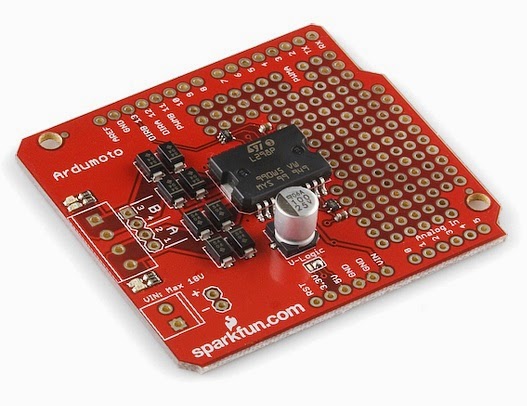
  3. Ardumoto - Motor Driver Shield -- $24.95 -- "This is a motor shield for Arduino that will
    Ardumotor from SparkFun
    control two DC motors. Based on the L298 H-bridge, the Ardumoto can drive up to 2 amps per channel. The board takes its power from the same Vin line as the Arduino board, includes blue and yellow LEDs to indicate active direction, and all driver lines are diode protected from back EMF
    ."
  4. Monster Moto Shield -- $69.95 -- "This is essentially a ramped up version of our Ardumoto motor driver shield. For this monster shield we’ve replaced the L298 H-bridge with a pair of VNH2SP30 full-bridge motor drivers. We’ve also beefed up the support circuitry so this board is capable of driving a pair of high-current motors!"
  5. EasyDriver Stepper Motor Driver -- $14.95 -- "The EasyDriver is a simple to use stepper motor driver, compatible with anything that can output a digital 0 to 5V pulse (or 0 to 3.3V pulse if you solder SJ2 closed on the EasyDriver). EasyDriver requires a 7V to 20V supply to power the motor and can power any voltage of stepper motor."
If you use large motors or lots of motors on your MCU projects and could really use the Arc-Controller, you may want to head over to their Kickstarter page and support their campaign. If you know of other motor shields that do pretty much the same thing, send an email to arcatabob (at) gmail {dott} com and let me know what you use or recommend, and Ill update the post with that info.

**********
Read More..

Rabu, 20 April 2016

ONE MORE DAY ONE MORE METHOD

Swirl Tanks
After the last issue I thought it only fitting that we address Swirl Filter Tanks. So we need to look at what they are, what they do and how they do it...

 As usual I will let the net do the talking for us all...


 Before we continue lets recap on what were trying to achieve;
Biological Filtration and the Nitrification Cycle
A biological filter is quite simply the heart of a pond or tank. It is not essential in small fish ponds, but the more fish you stock, the larger they get and the more they eat, so the need for a bio-filter becomes greater. The pond gets to a point where it needs a "sewage farm". Its purpose is to convert the waste matter produced by the koi from harmful ammonia into less toxic waste.
It is less important to remove solids particles from water than it is to process nitrogen, so if there is to be a compromise between mechanical and biological, err on the side of biological.
In other words, it is much better to allow particles below a certain size to escape back into the pond, while converting a great deal of ammonia to nitrate, than it is to catch every little thing down to a micron or less which in the process would slow the water down to the point where the bacteria have a hard time living (because theyre not getting enough oxygen).


The bacteria that convert ammonia to nitrate for us are among a class of bacteria that you may have heard of before. They are the so-called, “nitrogen fixing” bacteria. This means that they take nitrogen that is unavailable to plants in its ammoniacal form, and make it available to plants in an oxidized form.


These are the same bacteria that live among the roots of leguminous plants. Without these beneficial bacteria, life as we know it would cease. So be kind to your bacteria. What they need to survive is a large surface area, chemically inert medium and a ready supply of fresh water. They depend upon dissolved oxygen in the water to live and to do their job. As soon as the water flow is stopped, the oxygen in the filter becomes finite, and eventually gets used up. 


The ultimate result is that the bacteria die, and you have to start over.

Now is this acceptable Information? If it is, Here it is in FULL Its from a Koi keeper but he has described it all in a way that I feel comfortable with.

Now lets take a look from the pure swirl point of view

And now we can hit the subject from a few different angles

Going back a bit to 2007

And finally Afnan touches on filtering (if you can find it down near the bottom) but the search is so worth while.

Just a tip to finish off. If you have trouble in the winter months keeping the fish tank temperatures up, shut down the pump through the night but dont forget to turn it back on in the morning.
REASON: The growbeds act as/like an evaporative air conditioner (in reverse) and release the warmth to the air so you can lose several degrees of temperature every night.

OK. Im done. Hope you are getting something out of all this.
Be Back SOON


O Z Z I E
Read More..

Senin, 28 Maret 2016

Well there are still more Great Sites for us to visit

Here we are, the middle of another week and all sorts of things keep turning up. So Ill see if I can make head or tail of some of it.....:But First - I said on Monday I would make it up to you - Well Heres Your Bumper Crop:
.................................................................................................


Courses, Workshops & Events


For Upcoming Courses, Workshops, & Events in Permaculture, Ecovillage Design, Sustainable Living Skills, & More
Resource?Center
2008, Living Mandala
creative services by: 360 Degrees

In Association With

Nor Cal Aquaponics

Mendocino Ecological Learning Center


Facilitators & Instructors

Max Meyers

David William House

Chris Byrne

Guests Instructors TBA


Course Inspiration

What if there was way to produce an abundance of organic food using 98% less water, while producing up to ten times more food in the same amount of area and time? What if you could achieve this using 1/4 the amount of energy, in a system that does not require fertile soil, saves you labor, makes you a good living and is incredibly sustainable?

                                                      ...oooOooo...

Experts release qualified information on sustainable food production.
Right and wrong methods – and little pointers that will rapidly increase food productivity and bio-security with functional foods!


FOR IMMEDIATE RELEASE
PRLog (Press Release) – Feb 03, 2011 – I could hear the spruiker calling out to the public as they walked past "Come on a journey with Australian Andrew S. de Dezsery, M.Sc and International Specialised Skills Industry Fellow as you learn Aquaponics 101The who, how to, where and what!” he cried.

                                                      ...oooOooo...

 From Murray Hallam
The First 12 Months and DIY Toteponics.
Posted on February 9, 2011 by Murray

Guest post by Eco Films.

Just a quick update on what’s happening with the upcoming DIY Aquaponics DVD. The DVD is complete and ready to go. We’ve been waiting for Murray Hallam to complete his accompanying pdf file that will be included with the disk and today we got his first draft and boy is it looking good. We were expecting a plan with measurements of the various layouts of the IBC container, but Murray has submitted almost a detailed book, full of photos, graphics and an extensive parts list with a...


                                                      ...oooOooo...

Herring Gut students learn from experience
by Alexandria Brasili
School of Roots students with harvested greens. L-R: Kyle, Tyler, Jack, Savanah Photo: Alexandria Brasili
Its a cold winter day in Port Clyde. While all is quiet and snowy outside, inside Herring Gut Learning Center its a completely different story. Students dart back and forth in rubber boots and aprons with baskets of fish and clipboards, yelling out weights and quantities in order to determine tank stocking densities. The group shrieks as a fish flops out of a basket and onto the floor. One brave student cups the fish under the belly and over the nose, a handy technique for ensuring that the fish doesnt wiggle out onto the floor again. Meanwhile, students in the greenhouse work in t-shirts, planting and harvesting crisp heads of bright green Bibb lettuce while snow gently falls outside.

                                                      ...oooOooo...

West Chatham Events CalendarWest Chatham Events Calendar
Posted: February 9, 2011 - 12:20am  |  Updated: February 9, 2011 - 3:18am
Advertisement
By Savannah Morning News

TODAY

"Club 316"

5-7 p.m. Feb. 9, Salvation Army, 3000 Bee Road. There will be cooking, sports, Bible study and more for ages 4-18. Free. For information, call 912-352-8366.

Opening Reception for "New Beginnings"

6:30 p.m. Feb. 9, Gallery S.P.A.C.E., 9 W. Henry St. The youth art exhibition celebrates the talent of local middle...[MORE]

                                                      ...oooOooo...

   
Aquaponics Systems Work With Nature Instead Of Against It

By , on February 16th, 2011%

Growing plants in the ground the old fashioned way may seem like the natural way to grow plants, but in reality, you are working against nature that way. It starts out by...
                                                      ...oooOooo...

 From YAHOO ANSWERS
Aquaponics , how to build aquaponics Garden?
I am trying to build my own aquaponics garden, but i am having trouble completing th eproject. Thus far i have been relying on forums and free guides. All the guide I have found are either: Harder to understand, incomplete, or just dont work. I know they are well intentioned but i want a professional guide that will lead me through the process step by step. Any suggestions? Read on for the Answers...

                                                      ...oooOooo...

Aquaponics

by Walter Newsom
(Gilbert, AZ, USA)
Tilapia from our tanks
We have a small acreage in Arizona that we raise our chickens for eggs, calves for beef and fruit trees. As we aged, we found that raising beef was too expensive and we needed protein that was more digestable.

We started raising talapia in tanks in our back yard 2 years ago. We us... Get the Full Story HERE
                                                      ...oooOooo...

Aquaponics For The Beginner - 5 System Considerations And Requirements
By K Bray Platinum Quality Author

You can set up your own aquaponics system rather easily however there are some factors you need to consider and understand before you get started. The first item is selecting your location, if you have limited space then this will determine the size of your grow beds and the fish tank.
                                                      ...oooOooo...

Aquaponics and Apartments… oh yes!

Photo Courstey: AquaBundance Aquaponics System $1295 retail

With more people moving into apartments from single-family residences, property managers have begun to encounter resident hobbies and behaviors that can be challenging. One of these is the practice of aquaponics, or raising fish and plants together in a tank and plant medium system.

How does it work? A very organic process recycles the fish excrement into plant fertilizer and as the plants grow they

                                                      ...oooOooo...

Grow Leds Hydroponic Aquaponic hps mh solar indoor whatever

Im sick of foreign countries controlling our shit. no offense, jus sick of it..German Hydroton, Netherland rockwool, south american or indian coir , saudi oil or chinese everything else..cmon America .put our heads together.
                                                      ...oooOooo...

Maui Sustainability Learning Center open for volunteers
Banana starts are planted in the Canoe Garden.


Advertisement
LAHAINA — Lahaina’s new sustainability center in Launuipoko invites the public to come and help with its monthly projects.

Established in 2010, the Maui Sustainability Learning Center, a 501 (c)(3) nonprofit organization, already has plantings of bananas, breadfruit and sugarcane in its Canoe Garden, with plans for many more plants that the early Polynesians brought to Hawaii in their canoes.

                                                      ...oooOooo...

Farmer-Chef Conference to be held in Buffalo.

Hyatt Regency Buffalo will play host to the Third Annual Farmer-Chef Conference on Monday, February, 21.
             
The theme this year is "Bridging the Farm to Table Gap" meaning all farmers, restaurateurs, and related professionals will gather and build awareness of Western New Yorks agricultural products, their quality, and accessibility to restaurants and the food industry in general.
                                                      ...oooOooo...

Toquaht chief speaks at Seafood Summit
Land-based aquaculture could be future for First Nation community
Julia Prinselaar, Westerly News

Toquaht First Nation chief Anne Mack attended last weeks Seafood Summit in Vancouver and made a presentation about a proposed aquaculture park within her territory.

"At this point were in the early stages," said Mack, who was part of a panel discussing the business of land-based closed containment salmon farming.

                                                      ...oooOooo...

Ryan Lilleys Page
We area a group of students from Santa Barbara City College building an Aquaponic Systems for our class called Projects in Sustainability
                                                      ...oooOooo...
Well, that should satisfy the best of you. I sure hope so....I got RSI of my two typing fingers...
So, have a good week [Whats left of it]
Soon
O Z Z I E
Read More..

Sabtu, 26 Maret 2016

MCU Music Home Multi zone Arduino Audio

Members of the Humboldt Microcontrollers Group have a more than average interest in microcontrollers (MCUs) and music, e.g. the Humboldt Laser Harp (HLH) and Raspberry Pi music systems.

Weve got the proof-of-concept HLH working, but we need to take the next step in expanding the musical capabilities of the HLH. After I talk with Ed, Nick and others in the MCU group about how to most cost effectively improve the music from the harp, Ill write a post about electronic music component options. In the meantime, heres an MCU music topic I read about in an August 2014 Atmel blog post.
Custom PCB fabbed by OSH Park

The Atmel post points to an Instructables titled "The Smartphone Operated House-Wide Audio System" that talks about a system that:
"...solves the seemingly ubiquitous problem of being able to listen to your music from anywhere in your house. Say goodbye to a separate iPod dock in each room! This instructable will show you step-by-step how to build a house wide, multi zone audio system which can be entirely controlled from your Smartphone or computer (really anything with a web browser) from anywhere in your house which you have a Wifi connection...its also expandable to however many zones you need...this system allows you to use speakers and amps of your choosing and at a fraction of the cost of a Sonos system. In this project we will be making use of an Arduino uno with an ethernet shield and a custom PCB which can be ordered from your favorite PCB manufacturer (I recommend OSH Park). The central component of the PCB is the PT2258 IC. This IC allows for volume control of 6 audio channels and communicates with the Arduino over the I2C bus."
Arduino with Ethernet shield and custom PCB with PT2258 IC
The Princeton Technology datasheet for the PT2258 IC shows the block diagram and pin configuration for this component. Reading over the Tutorialsto.com write-up about the IC will give you a general understanding of the component if you dont already know what it is.

Lepai LP-2020A+ amplifier
This MCU project is more complicated than some projects in other posts Ive written, but it will give you good experience in doing activities like ordering a custom PCB (printed circuit board), soldering components on the custom PCB, and hooking up your fabbed and assembled custom PCB with a 6-channel amp and power supply. The Instructables has a pretty good set of photos showing how to solder the components on the PCB, so dont worry about that step if you havent assembled many, or any, PCBs. The two amplifier options listed in the project write-up both look fun to work with; a Lepai LP-2020A+ for about $20 or a Parts Express AA-AB34181 for about $60.

The Instructables project author describes using the finished audio system this way:
Parts Express AA-AB34181 amplifier
"In order to maintain the idea of being able to control the system from a smartphone, I used a Chromecast with an HDMI audio extractor. This allows us to take the audio the Chromecast outputs and plug it into our PT2258 control board. Thus we can simply cast our favorite Pandora station or music from Google Play Music to the Chromecast and control the volume from our Arduino. Simply plug the Chromecast into a TV and set it up on your home network, then unplug it from the tv and plug it into the HDMI audio extractor. Using a RCA to 3.5mm cable, plug the HDMI audio extractor into the input of the PT2258 board...The system can be controlled by anything which has a web browser and is connected to your home network. All you have to do is type in the IP address of the arduino followed by "/?app" (i.e. 192.168.1.199/?app) and you will be brought to the control app for the system...The greatest limitation of this system is the fact that there is only one audio input for the entire system. That means you have to listen to the same song throughout the entire house."
This system costs about $300 to build, so I wont be putting one together any time soon, but the project gives a good overview of setting up a pretty versatile home audio system from scratch.

**********
Read More..

Selasa, 22 Maret 2016

More for Newbies and then some

Keeping the trend going, There are several interesting sites that are just begging to be looked at that are full of vital information.
So often we can go to a site and after reading a few lines we find within ourselves a feeling of false security because there seems to be nothing that we havent already read or heard.
The problem is, there could be a little gem in the very next line or paragraph. Some experience or problem that has been overcome the hard way. Something that leaves us with "Thank God I kept Reading".
They say there is nothing you cant find on the web. But you need persistence and really well organized search techniques. 
Or just keep reading what we have here......lol

It does take time and effort to learn how to operate a system and anyone who says different would be telling a lie, but in the end...

systems can actually produce 8 to 10 times the volume of vegetables in the same space and time as conventional farming systems.This makes aquaponics an...

Lloyd Fischel of Lanikai Farm will welcome attendees for a tour of his aquaponics system, where he...

The tilapia fish are still alive and swimming and the plants that are growing in the nutrient laden water are growing quite well. I have to say the...

Aquaponics is the symbiotic cultivation of plants and aquatic animals in a recirculating environment....

Ideas included geothermal and passive solar greenhouses; aquaponics — to raise fish and produce in small urban spaces; edible landscapes....

WARNING....This is an MJ grower but his Videos are SO GOOD...

OK, Like I said above always read the fine print - There is always something new.....

And where it all Started....
On an eighth of an acre, a person can produce 25,000 pounds of food, Rakocy said. Of that, 11,000 pounds are fish and 14,000 pounds are vegetables.

That might do for today..

But just to update you on our progress, our BSF gear is now moving along and flies are laying so the lavae will soon be appearing, our test unit is still operational and the major setup is starting to look something special. Will include photos soon..

All the Best
Ozzie


Read More..